


 , single scattering albedo and the moments of the scattering
phase function. Thus, we are faced with two problems. First, we neither know
the optical parameters of the aerosol cloud nor do we know their temporal
change, apart from the .
Second, we cannot assume a plane-parallel layer but have to consider a
spherical layer and have to deal with
large zenith angles, i.e. close to
, single scattering albedo and the moments of the scattering
phase function. Thus, we are faced with two problems. First, we neither know
the optical parameters of the aerosol cloud nor do we know their temporal
change, apart from the .
Second, we cannot assume a plane-parallel layer but have to consider a
spherical layer and have to deal with
large zenith angles, i.e. close to  .
Thus, we decide to assume an exponential behaviour as it is supposed in
the most simple solutions of the radiation transfer equation
and adapt it to observations.
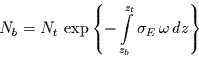
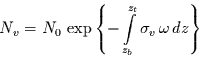
The weakening effect of a ray passing through a layer follows from the
RTE as
.
Thus, we decide to assume an exponential behaviour as it is supposed in
the most simple solutions of the radiation transfer equation
and adapt it to observations.
The weakening effect of a ray passing through a layer follows from the
RTE as
 |
= | radiative energy flux at the bottom of the aerosol layer, |
 |
= | radiative energy flux at the top of the aerosol layer, |
 |
= | top of the aerosol layer, |
 |
= | bottom of the aerosol layer, |
 |
= | ratio between the vertical thickness of the layer and the ray path, and |
 |
= | extinction coefficient within the aerosol layer. |
nor on the factor , we also
neglect an explicit consideration of foreward scattered radiation.
Anyway,
if the part of foreward scattered radiation is proprotional to the extinction
we are not wrong if we use equation (7) with a calibration
coefficient  to be estimated from observations (see section 4).
Regarding
to be estimated from observations (see section 4).
Regarding  as the sum of the extinction coefficients with
and without volcanic aerosol,
as the sum of the extinction coefficients with
and without volcanic aerosol,  and
and  respectively,
we can rewrite equation (7) as
respectively,
we can rewrite equation (7) as
 radiative energy flux at the bottom of the undisturbed
layer (without any volcanic aerosol) and
radiative energy flux at the bottom of the undisturbed
layer (without any volcanic aerosol) and  radiative energy flux
at the bottom of the volcanic aerosol layer.
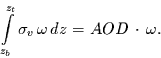
Because of the very weak dependence of from
radiative energy flux
at the bottom of the volcanic aerosol layer.
Because of the very weak dependence of from  within the
stratosphere we can further write
within the
stratosphere we can further write
 with respect to
volcanic stratospheric aerosol is now given as the difference between
with respect to
volcanic stratospheric aerosol is now given as the difference between
 and
and  . To obtain an approximated forcing
  , the
vertical portion of the downward energy flux change
, the
vertical portion of the downward energy flux change
![\begin{displaymath}
\Delta N_{\perp} = N_{0,\perp}\cdot [1-\exp(-AOD \omega)]
\end{displaymath}](img88.gif) |
(10) |
 . The observed
volcanic has to be multiplied by the
calibration coefficient to consider that it is a bulk property and
that we neglect an explicit description of the scattered radiation.
Thus we get
depends weakly on latitude and time within
the latitude belts
. The observed
volcanic has to be multiplied by the
calibration coefficient to consider that it is a bulk property and
that we neglect an explicit description of the scattered radiation.
Thus we get
depends weakly on latitude and time within
the latitude belts  and time steps
  . Thus, we approximate all variables
by their corresponding latitude-belt and time-step averages.
Therefore depends on and , while all other variables depend on and
have an annual cycle. The mean annual cycles of
. Thus, we approximate all variables
by their corresponding latitude-belt and time-step averages.
Therefore depends on and , while all other variables depend on and
have an annual cycle. The mean annual cycles of  and
are taken from a Fourier-Legendre-decomposition applied by North and
Coakley (1979).
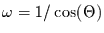
The ratio between
the ray path
and
are taken from a Fourier-Legendre-decomposition applied by North and
Coakley (1979).
The ratio between
the ray path  and the thickness of the layer
  depends on the zenith angle
  of the incoming solar radiation.
It is usually set to
of the incoming solar radiation.
It is usually set to
 which is applicable for
 . For close to , i.e. at sunrise
and sunset,
. For close to , i.e. at sunrise
and sunset,
 diverges and therefore this parameterization
would overestimate the forcing. To meet this problem, we consider the
curvature of the stratospheric aerosol layer and use a more realistic
parameterization of .
We
consider no refraction and therefore the ray path is a straight line.
According to observations (Deshler, 1993)
we regard the aerosol layer as homogeneous with a thickness
diverges and therefore this parameterization
would overestimate the forcing. To meet this problem, we consider the
curvature of the stratospheric aerosol layer and use a more realistic
parameterization of .
We
consider no refraction and therefore the ray path is a straight line.
According to observations (Deshler, 1993)
we regard the aerosol layer as homogeneous with a thickness  and a bottom height
  of
of  above the Earth surface.
Therefore the layer has
a curvature with the radius
above the Earth surface.
Therefore the layer has
a curvature with the radius  at the bottom and
 at the top, if
  is the Earth radius.
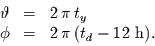
According to Figure 2 the ray path is given by
itself is
a function of latitude
is the Earth radius.
According to Figure 2 the ray path is given by
itself is
a function of latitude  , the time within the year
  , and
the time within the day
, and
the time within the day  (e.g. Monin, 1986):
 |
(15) |
is averaged
over the day light period. The borders of the integral are taken from
(13) under the condition  which means sunrise and
sunset and depend from latitude and time within the year.
Inserting equation
(14) in (13) and the resulting one in (12)
we find an expression of
which means sunrise and
sunset and depend from latitude and time within the year.
Inserting equation
(14) in (13) and the resulting one in (12)
we find an expression of
 as a function of
latitude and time within the year.
Using this approximation, is restricted to be smaller than 13 in the
case of
as a function of
latitude and time within the year.
Using this approximation, is restricted to be smaller than 13 in the
case of
 (sun position at the horizon).
Although we use a crude approximation compared to detailed solutions of the
RTE, we realize two important facts: the seasonal and spatial
patterns of the undisturbed radiation uptake
(sun position at the horizon).
Although we use a crude approximation compared to detailed solutions of the
RTE, we realize two important facts: the seasonal and spatial
patterns of the undisturbed radiation uptake
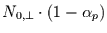 given by North and Coakley (1979) and the
seasonal and spatial patterns of the ratio .
given by North and Coakley (1979) and the
seasonal and spatial patterns of the ratio .
![\begin{displaymath}
\Delta Q = N_{0,\perp} (1-\alpha_{p}) \left[1-\exp\left(-AOD\cdot\omega\cdot p_{2}\right)\right].
\end{displaymath}](img90.gif)
![\begin{displaymath}
\begin{array}{lcl}
l & = & a_{2}-a_{1}\\
a_{1} & = & \fr...
...R_{t}} \sin (\pi - \Theta)
\right]
\right\}.
\end{array}
\end{displaymath}](img101.gif)

