


Next: Stratospheric transport of volcanic
Up: Volcanic aerosol optical depth
Previous: Volcanic aerosol optical depth
Assessments of volcanic aerosol mass loading of the stratosphere
In order to estimate time series of the spatial patterns of
volcanic aerosol optical depth ( ) variations of the
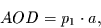
stratosphere we assume that is linearly proportional to the
volcanic aerosol mass concentration
) variations of the
stratosphere we assume that is linearly proportional to the
volcanic aerosol mass concentration  ,
,
 |
(2) |
where  is a scale factor. To calculate horizontal
space-time patterns of the volcanic aerosol mass concentration following an
eruption, we use a stratospheric transport parameterization
to describe the spreading of the aerosol within the
lower to mid-stratosphere, presented in section 2.2.
To describe the production and sedimentation of the aerosol
we use a time function which depends on latitude as well as the season and
time after eruption, introduced in section 2.3.
As an assessment of the strength
is a scale factor. To calculate horizontal
space-time patterns of the volcanic aerosol mass concentration following an
eruption, we use a stratospheric transport parameterization
to describe the spreading of the aerosol within the
lower to mid-stratosphere, presented in section 2.2.
To describe the production and sedimentation of the aerosol
we use a time function which depends on latitude as well as the season and
time after eruption, introduced in section 2.3.
As an assessment of the strength  of a volcano eruption, the
Volcanic Explosivity Index (
of a volcano eruption, the
Volcanic Explosivity Index ( ), provided by
Simkin et al. (1981) and actualized by Siebert (1993), is used where
), provided by
Simkin et al. (1981) and actualized by Siebert (1993), is used where
 for large eruptions with a column height of at least
10 to 25 km (
for large eruptions with a column height of at least
10 to 25 km ( ) and zero otherwise.
We neglect eruptions with
) and zero otherwise.
We neglect eruptions with  because they are not supposed
to inject precursors of aerosols into the stratosphere (Simkin et al., 1981).
The actualized version also takes into account the
results of Robock and Free (1995) who argue that the
Mount St. Helens eruption
(1982) was only of
because they are not supposed
to inject precursors of aerosols into the stratosphere (Simkin et al., 1981).
The actualized version also takes into account the
results of Robock and Free (1995) who argue that the
Mount St. Helens eruption
(1982) was only of  instead of 5 and Agung eruption (1963) was of
 instead of 4. These two examples show that it is very difficult to
get reliable information about the strength of eruptions before the period
of detailed instrumental observations.
Nevertheless, for some strong volcanic eruptions the stratospheric
mass loading is known from observations or is estimated indirectly.
Since the
middle of the nineteenth century six volcanic eruptions occured
with a of 6.
For all these eruptions estimates of stratospheric aerosol mass loading
are provided by several researchers using different methods. Stothers (1996)
presents an overview of the results and a comparison with his own
investigations. We list these estimated stratospheric aerosol loading
in Table 1. The averaged stratospheric aerosol loadings
of the six most recent
eruptions with amounts to
instead of 4. These two examples show that it is very difficult to
get reliable information about the strength of eruptions before the period
of detailed instrumental observations.
Nevertheless, for some strong volcanic eruptions the stratospheric
mass loading is known from observations or is estimated indirectly.
Since the
middle of the nineteenth century six volcanic eruptions occured
with a of 6.
For all these eruptions estimates of stratospheric aerosol mass loading
are provided by several researchers using different methods. Stothers (1996)
presents an overview of the results and a comparison with his own
investigations. We list these estimated stratospheric aerosol loading
in Table 1. The averaged stratospheric aerosol loadings
of the six most recent
eruptions with amounts to  . Assuming that a volcanic
eruption with leads exactly to an aerosol loading of 25
. Assuming that a volcanic
eruption with leads exactly to an aerosol loading of 25  we
obtain the following equation to correct the data in respect
to the estimated stratospheric aerosol loading
we
obtain the following equation to correct the data in respect
to the estimated stratospheric aerosol loading  :
:
 |
(3) |
The corrected values are listed in the last column of Table 1.
For volcanoes with  estimates of stratospheric mass loading
exist, too (Stothers, 1996). We also correct the of these volcanoes
with respect to the observations using
equation (3). The results for the strongest observed eruptions
since 1880 are listed in Table 2. For our further investigations
we use the series with corrected values.
estimates of stratospheric mass loading
exist, too (Stothers, 1996). We also correct the of these volcanoes
with respect to the observations using
equation (3). The results for the strongest observed eruptions
since 1880 are listed in Table 2. For our further investigations
we use the series with corrected values.
Next: Stratospheric transport of volcanic
Up: Volcanic aerosol optical depth
Previous: Volcanic aerosol optical depth
ich
2000-01-20